Best Bilge Pump Options for Pontoon Boats: 5 Top Selections for Safe Decks
Answering your need for reliable bilge management on a pontoon boat, these pumps cover automatic and manual options at various flow rates. They’re suited for boaters who want quick water evacuation, easy installation, and durable builds. The top picks include automatic models for unattended operation and high-capacity pumps for larger pontoons or frequent splashes. Use this guide to compare features, best-use scenarios, and potential limitations for each choice.
| Product | Best For | Key Benefit |
|---|---|---|
| Shoreline Marine Fully Submersible Bilge Pump, 600GPH | Moderate needs; reliable automatic control | Self-contained automatic switch; durable housing |
| Subtoy 12V Automatic Bilge Pump Kit, 1100GPH | Runabouts and larger pontoons | Built-in float switch; complete kit |
| MAXZONE Submersible Bilge Pump, 1100GPH | High-capacity, quiet operation | High flow; submersible design |
| Sanuke 1100GPH Bilge Pump, 12V | Harsh marine environments; anti-airlock | Anti-Airlock Technology; long service life |
| Rule 500 GPH Electronic Sensing Bilge Pump | Efficient, energy-conscious setups | Low power draw; automatic checks |
Shoreline Marine Fully Submersible Bilge Pump, 600GPH

Flow rate and automatic control make this 600 GPH pump a solid all-around choice for pontoon crews needing dependable, unattended operation. Its fully submersible plastic housing is designed to withstand harsh marine environments, and the universal mounting base aids quick installation and cleaning. Best for boats with moderate bilge activity where an automatic response to rising water is desired.
Who it’s best for: boaters seeking a compact, self-contained automatic pump that’s easy to install and maintain. Why selected: balanced performance, durability, and simple mounting. Limitation: lower flow compared with high-capacity models, so it’s best for smaller bilges or lighter water loads.
MAXZONE Submersible Boat Bilge Pump 12V 1100GPH
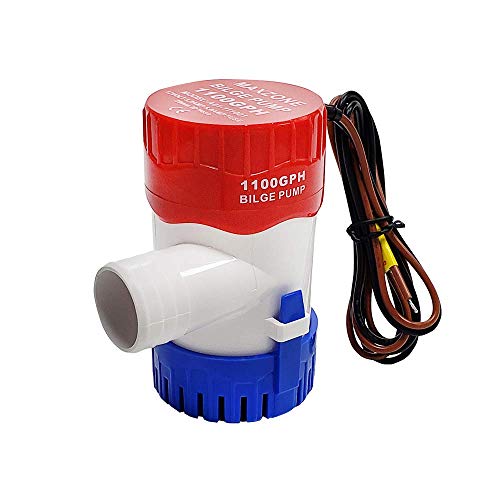
This 12 VDC pump delivers about 1100 GPH with a 1-1/8″ outlet and 13 ft head, designed for reliable water evacuation in boats, ponds, pools, and similar environments. Best for pontoons that experience frequent water intrusion or require stronger drainage. Limitation: not explicitly automatic in the listed data; pairing with a float switch may be necessary for unattended operation.
Subtoy 12V Automatic Bilge Pump Kit, 1100GPH
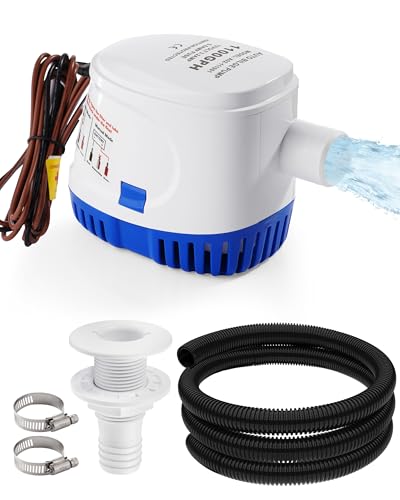
With an automatic built-in float switch, this kit pumps up to 1100 GPH and includes hose and thru-hull fittings. It’s suited for pontoons needing quick response to rising water and a ready-to-install package. Best for owners who want a complete, ready-to-run solution. Caution: verify compatibility with hull fittings and ensure the included hose fits your setup.
Rule 500 GPH Electronic Sensing Bilge Pump

Automatic sensing with 2″ activation for standard checks and 5/8″ activation for the higher-capacity pump provides a reliable safety net for small to mid-sized pontoons. It features a low power draw (0.20 amps) and a threaded port design to simplify installation without needing a separate float switch. Best for energy-conscious boats wanting straightforward setup. Limitation: lower flow compared to high-capacity 1100 GPH models.
Attwood Tsunami Mk2 Tsunami 12V Manual Bilge Pump, 800 GPH

While this is a manual pump, it is included here for pontoon buyers who want a reliable backup option or manual control during maintenance. It excels in freshwater conditions and features air-lock elimination for dependable pumping. Best for redundancy on pontoons where manual intervention is acceptable. Caution: not automatic; requires manual operation when needed.
Buying Guide
Key considerations for selecting a pontoon bilge pump include flow rate, automation, durability, and installation compatibility. Battery voltage and power consumption matter for long trips. Automatic models with float switches offer unattended operation, while manual options provide backup control during maintenance or power issues. Submersible designs help prevent corrosion in saltwater or humid environments, and outlet size should match your hose fittings.
- Flow capacity: Choose 600 GPH for smaller pontoons or light bilge loads, 1100 GPH for larger pontoons or frequent water intrusion.
- Automatic vs manual: If you want unattended drainage, prefer a pump with an automatic switch or float.
- Power efficiency: Pumps with low amp draw save battery life on longer trips.
- Durability: Look for waterproof housings and corrosion-resistant materials.
- Installation: Check outlet size, mounting options, and whether a full kit is included.
- System integration: Consider whether you need a complete kit (hose, fittings) or just the pump.
Frequently Asked Questions
- What is the typical bilge pump flow rate for pontoon boats?
Answer: Pontoon boats commonly use 600–1100 GPH pumps, depending on hull size and how much bilge water is expected. - Should I choose automatic or manual bilge pumps for a pontoon?
Answer: Automatic pumps are preferable for unattended operation, while manual pumps serve as a backup during power or switch issues. - Can my bilge pump be submerged?
Answer: Yes, submersible designs are common and help protect against corrosion in marine environments when installed properly. - Is a complete kit better than buying a pump alone?
Answer: A complete kit (pump, fittings, hose) simplifies installation and reduces compatibility concerns, especially for first-time setups. - Do I need a separate float switch with an automatic pump?
Answer: Not always, as some models integrate a float switch; however, some setups still pair an automatic pump with an external switch for extra safety. - What are common limitations to watch for with high-flow bilge pumps?
Answer: Higher flow pumps may require more power and larger docking hoses; ensure battery capacity and wiring support the higher current draw.