Best Low Level Outdoor Lighting for Subtle Exterior Illumination
Low level outdoor lighting enhances safety and curb appeal without overpowering your landscape. This guide highlights five dependable options designed for pathways, borders, and hard-to-see zones. Best for: homeowners decorating walkways and accents; small businesses enhancing entryways; and renters seeking easy, non-permanent setups. Below is a quick summary of the chosen products to compare at a glance.
| Product | Best For | Power Type | Key Benefit |
|---|---|---|---|
| REEGOLD Low Voltage Landscape Lights Outdoor | Yards, paths, driveways | Low Voltage | Long service life; IP65 waterproof |
| hykolity Low Voltage LED Landscape Kits | Whole-yard lighting plans | Low Voltage | High lumen options; durable aluminum housing |
| Lumary Smart Landscape Lights Pro | Color-changing accents | Low Voltage, smart control | App/Remote/Voice control; wide color options |
| Paradise Plastic Path Stake Light (Black, 4 Pack) | Perimeter paths | Solar/Plug variants available | Simple stake design; clean, minimal look |
| 10in. Satin Black Angle Shade Gooseneck Sign Light | Entrance signs and decorative accents | AC LED with 9W bulb | Vintage style; long extension arm |
REEGOLD Low Voltage Landscape Lights Outdoor

Best for: residential pathways and garden borders that require steady, reliable illumination. This 6-pack uses 12V–24V low voltage lights with 7W 700LM outputs, designed for long operation life and consistent brightness. The aluminum body improves heat dissipation versus plastic, helping maintain lumen output. IP65 waterproof rating protects against rain and spray. Choose this if you want durable, scalable landscape lighting that can be wired to existing low voltage systems. Caution: installation requires low voltage wiring and power source; ensure proper wiring to avoid short circuits.
hykolity Low Voltage LED Landscape Kits

Best for: homeowners planning a complete yard lighting scheme. The kit includes multiple fixtures with 8-pack options and a variety of wattage equivalents (20W/30W range conceptual equivalents), built from die-cast aluminum for durability. They support low voltage setups commonly used for outdoor landscapes and offer weather resistance for outdoor use. Benefit: modularity lets you expand lighting as needed. Limitation: exact lumen output per fixture varies by kit and bulb choice; check compatibility with your transformer and wiring plan.
Lumary Smart Landscape Lights Pro 500LM
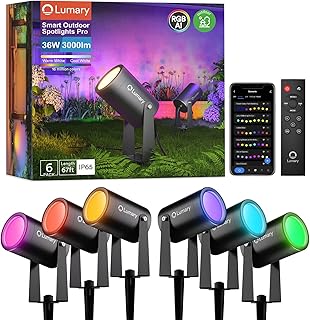
Best for: users who want vibrant, programmable ambience. These 6-pack lights offer color changing options (RGBAICW) and IP65 waterproofing, with app/remote/voice control for easy customization. They are ideal for creating mood lighting along walkways, gardens, or entryways. Caution: smart features require compatible mobile device and app setup; ensure your Wi-Fi or hub supports the system.
Paradise Plastic Path Stake Light (Black, 4 Pack)
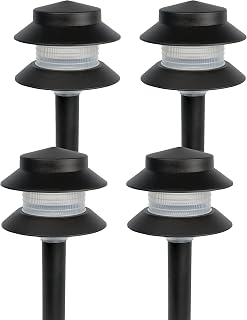
Best for: lightweight, budget-friendly perimeter lighting along garden paths. These stakes are simple to install and provide consistent illumination along walkways. Consider this option for short-term or decorative lighting where a discreet, unobtrusive profile is preferred. Limitation: plastic construction may be less durable in high-traffic areas or extreme weather; check local conditions and replacement needs.
10in Satin Black Angle Shade Gooseneck Sign Light

Best for: highlighting entry signs or architectural features with a vintage-tinged glow. The 9W LED A19 bulb provides about 900 lumens through a satin black gooseneck with a 22-inch extension arm. It suits entrances, storefronts, and farmhouse aesthetics. Choose this if you want a decorative, archival look with a practical reach. Caution: check compatibility with your preferred sign or mounting surface; ensure mounting hardware supports the 22-inch arm extension.
Buying Guide: Key Considerations For Low Level Outdoor Lighting
- Low voltage vs line voltage: Low voltage (12V–24V) systems are common for landscape lighting due to safety and easier wiring; line voltage offers more brightness but requires professional installation in many cases.
- Scope and spacing: Plan the number and placement of fixtures to avoid hot spots and dark patches. Path lights are ideal for guiding routes; spotlights emphasize features; signs benefit from planed reach and angle.
- Durability and weather resistance: Look for IP ratings (IP65 or higher) for water resistance; aluminum housings outperform plastic in heat dissipation and longevity.
- Control options: Basic on/off or dimming may be sufficient; smart options (app, remote, voice) provide scene control but require compatible devices and network.
- Brightness and color: Measured in lumens; white light is common for safety and visibility. Color-changing options add ambiance but require more setup and potential maintenance.
- Installation considerations: Verify transformer capacity for low voltage setups; ensure proper wiring paths, sealed connections, and secure mounting to prevent wind damage.
- Aesthetics and mounting height: Choose fixtures with finishes that complement the home or landscape. Gooseneck arms add reach and a classic look; stake lights offer a clean silhouette.
Frequently Asked Questions
- What is the best light type for pathways? A: Low voltage path lights are usually best, balancing safety, energy use, and ease of installation.
- Do I need a transformer for these lights? A: Yes, most low voltage landscape kits require a transformer to regulate voltage from the power source to the fixtures.
- Can I mix colored and white lights? A: Yes, mixing colors with white can create visual interest, but plan a cohesive palette to avoid clashing looks.
- Are solar path lights a good substitute? A: Solar lights are easy to install but may be less reliable in cloudy conditions or short days; they often have lower brightness.
- How long do LED landscape lights last? A: Many LED landscape lights are rated for tens of thousands of hours, but actual life depends on usage, weather, and build quality.
- Is smart lighting worth it for outdoors? A: Smart outdoor lighting adds convenience and customization, especially for larger properties, but requires compatible infrastructure and apps.